
A deep-amber, translucent plastic part that sits in hot water for the long term, must be safe for drinking-water contact, and has to withstand high temperature — that is a key component inside a thermostatic mixing valve, made of PEI (polyetherimide). Among high-temperature engineering plastics, PEI stands out on value: it costs far less than PEEK, yet its performance covers most 150–170°C service conditions.
1. When should you choose PEI?
Material selection starts with the service conditions. PEI is a particularly good fit in these scenarios:
- Long-term 150–170°C heat resistance when PEEK would be overkill — this is PEI's core positioning. PEEK reaches 250°C, but at a much higher price; when your conditions sit in the 150–170°C range, PEI is often the most cost-effective choice.
- Flame retardancy and low smoke without additive flame retardants — PEI is inherently self-extinguishing and naturally meets UL94 V-0, with no added retardants. Many plastics only reach the rating through additives, at the cost of mechanical and surface properties.
- Contact with drinking water or food — PEI carries US FDA, EU food-contact and NSF 51 listings, so it can be used directly in potable water and food equipment.
- Resistance to hot water, steam and repeated sterilization — PEI resists hydrolysis, withstands long-term hot-water immersion and autoclaving, and does not embrittle after repeated sterilization.
- Translucency plus high temperature — most high-temperature plastics are opaque; PEI is one of the few translucent high-temperature plastics, a deep amber you can see through.
- High rigidity, dimensional stability and low creep — PEI is an amorphous engineering plastic with high modulus and stable dimensions, suited to parts with precision fits such as threads and snap-fits.
2. PEI's special properties
Example: SABIC Ultem 1000, grade 1000-1000; data from the official datasheet.
| Property | Value | Note |
|---|---|---|
| Density | 1.27 g/cm³ | ASTM D792 |
| Glass transition Tg | 217°C | Heat ceiling of an amorphous plastic |
| Heat deflection HDT | 201°C @1.8 MPa | 210°C @0.46 MPa |
| Continuous use temp, UL RTI | 170°C | UL 746B |
| Flammability | UL94 V-0 @0.75mm | V-2 at 0.4mm thin wall; also 5VA |
| Tensile strength at yield | 110 MPa | ASTM D638 |
| Flexural modulus | 3.51 GPa | ASTM D790 |
| Elongation at break | 60% | Amorphous, good toughness |
| Water absorption | 0.25% (24h) | ASTM D570 |
| Listings | FDA / EU food contact / NSF 51 | In natural color |
A few properties worth calling out:
- Hydrolysis resistance — PEI works in water-contact environments and keeps its mechanical properties over long-term hot-water and steam exposure.
- Translucent amber — the color is fairly deep and transmits less light than PSU, but you can see through it, and the look is distinctive.
- Chemical resistance — it withstands acids and many solvents, but is attacked by strong alkalis and some halogenated hydrocarbons, so choose cleaning agents carefully.
- Halogen-free flame retardancy — naturally V-0 with no added retardants, low smoke and low toxicity, ideal for enclosed spaces such as aerospace and public transport.
3. Application areas
| Field | Typical uses | Why PEI |
|---|---|---|
| Plumbing / sanitary | Thermostatic mixing valve parts, hot-water fittings | Hot water + FDA potable + heat |
| Medical | Autoclavable instruments, trays, handles | Withstands 134°C steam, disinfectants |
| Aerospace | Interior parts, lightweight structural parts | Low-smoke V-0, light and strong |
| Automotive | Under-hood parts, headlamp reflectors, sensor housings | Withstands under-hood heat |
| Electronics | High-temp connectors, sockets, insulators | Heat + flame retardant + insulating |
| Food processing | Parts in contact with heat or steam | FDA food grade + high heat |
4. Case study: a PEI part in a thermostatic mixing valve
A thermostatic mixing valve is the safety component of a hot-water system — it blends hot and cold water to a set temperature to prevent scalding. Inside the valve there is constantly flowing hot water, so internal parts must satisfy several conditions at once: hot-water resistance, drinking-water contact, high-temperature endurance and dimensional stability.
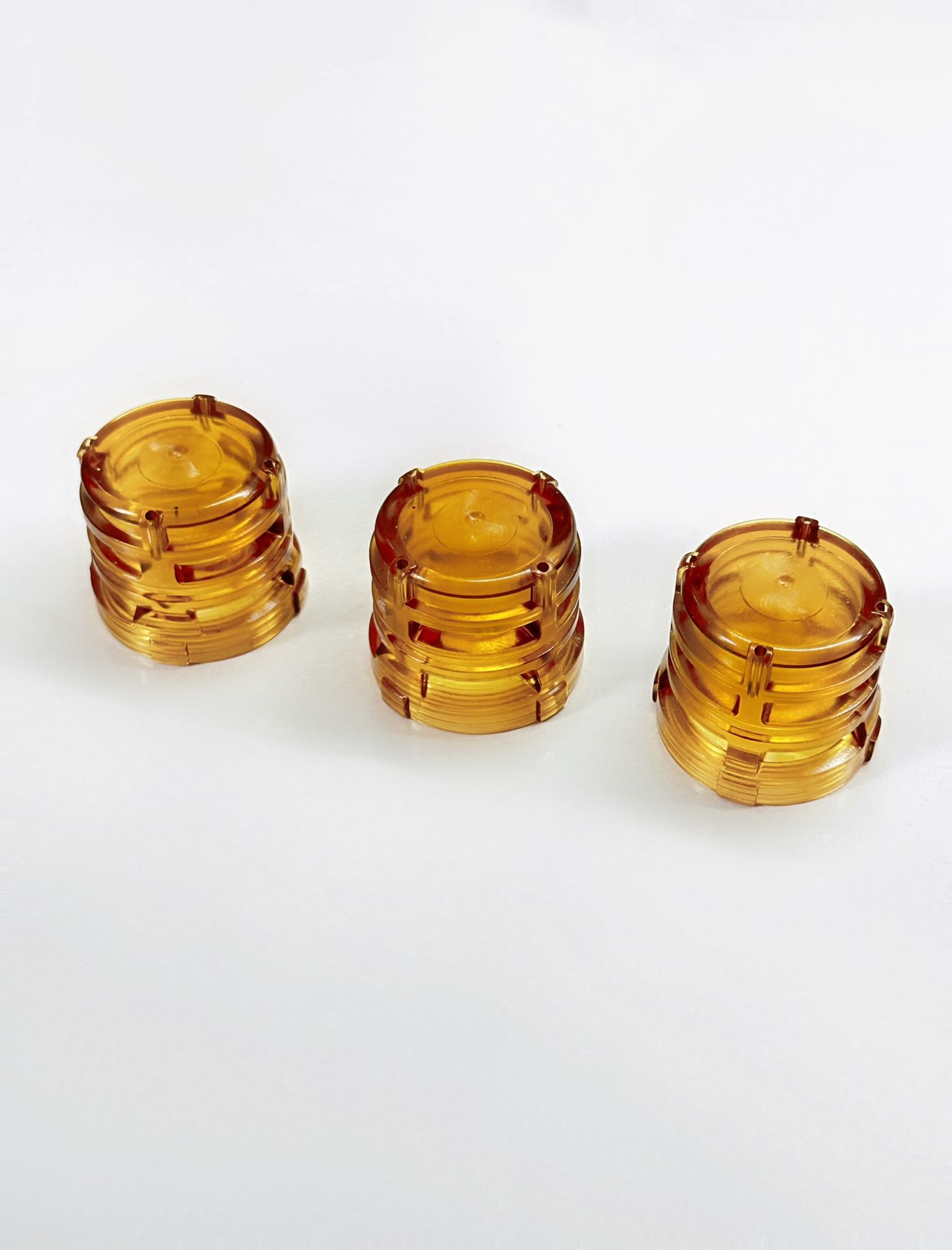
The PEI part we mold is a key functional component inside the valve cartridge, in direct contact with hot water. It relies on PEI's hydrolysis resistance, food-grade safety and precision dimensions.
5. Conclusion
PEI is a high-temperature engineering plastic; injection molding it demands high melt temperature (roughly 340–400°C), mold temperature (140–180°C) and careful drying. We handle everything from mold design to injection molding production in-house, with established process experience in high-temperature materials such as PEEK, PEI, PPS and PSU. Send us a drawing and we will help you evaluate whether PEI is the right choice — and give you a quote.